
FACEIT Rank Distribution 2026: A Simple Guide to Level 1-10
If you have ever wondered how your FACEIT level compares to everyone else, this guide answers that in plain terms. It covers what percentage of players sit at each level, why Level 4 is the most crowded rank, how rare Level 10 actually is, and what changed with Season 8. FACEIT itself does not publish this kind of data, so the numbers below come from two well known third party trackers that analyze real match data, and this guide explains both clearly so the figures actually make sense.
How Rare Is Reaching FACEIT Level 10
This question does not have one single answer, because it depends entirely on which group of players you are comparing yourself to, and most articles on this topic only show one side of it.
If you compare yourself to the entire FACEIT account base, including years old and inactive profiles, Level 10 is genuinely rare. It represents about 6 percent of all players, which works out to roughly one in every sixteen accounts that has ever held a level. That is a real accomplishment by any measure.
However, a separate study by Leetify looked only at currently active players, analyzing more than 600,000 unique accounts that were actively playing matches in March 2026. Among that group, the picture flips completely. Level 10 was the single most common rank, making up just over 20 percent of active players, while Level 1 shrank to barely more than 1 percent. Levels 4 through 9 were all fairly close to each other in that active only sample, each holding somewhere around 10 to 11 percent.
The reason these two pictures look so different comes down to who gets counted. The full account dataset includes every dormant, abandoned, or one time profile sitting untouched at low levels for years. The active only dataset strips all of that out and looks only at people who are currently grinding. Since FACEIT Elo never decays on its own, and since players who stick around long term tend to keep climbing rather than sliding back down, the active player pool naturally skews much higher toward the top. So if you are a regular player who plays consistently, the more realistic comparison is the active player number, which makes Level 10 a tough but genuinely achievable goal rather than a one in sixteen long shot. If you are comparing yourself to every account FACEIT has ever issued a level to, the six percent figure is the more honest benchmark.
There is one tier above Level 10 worth knowing about too, called Challenger. It is reserved for exactly the top 1000 players by Elo, and it exists because Level 10 itself has no upper Elo limit. A player who just crossed into Level 10 at 2010 Elo and a top global player sitting above 4000 Elo are technically both Level 10. Challenger is what separates the two.
What the FACEIT Level 1 to 10 Distribution Looks Like in 2026
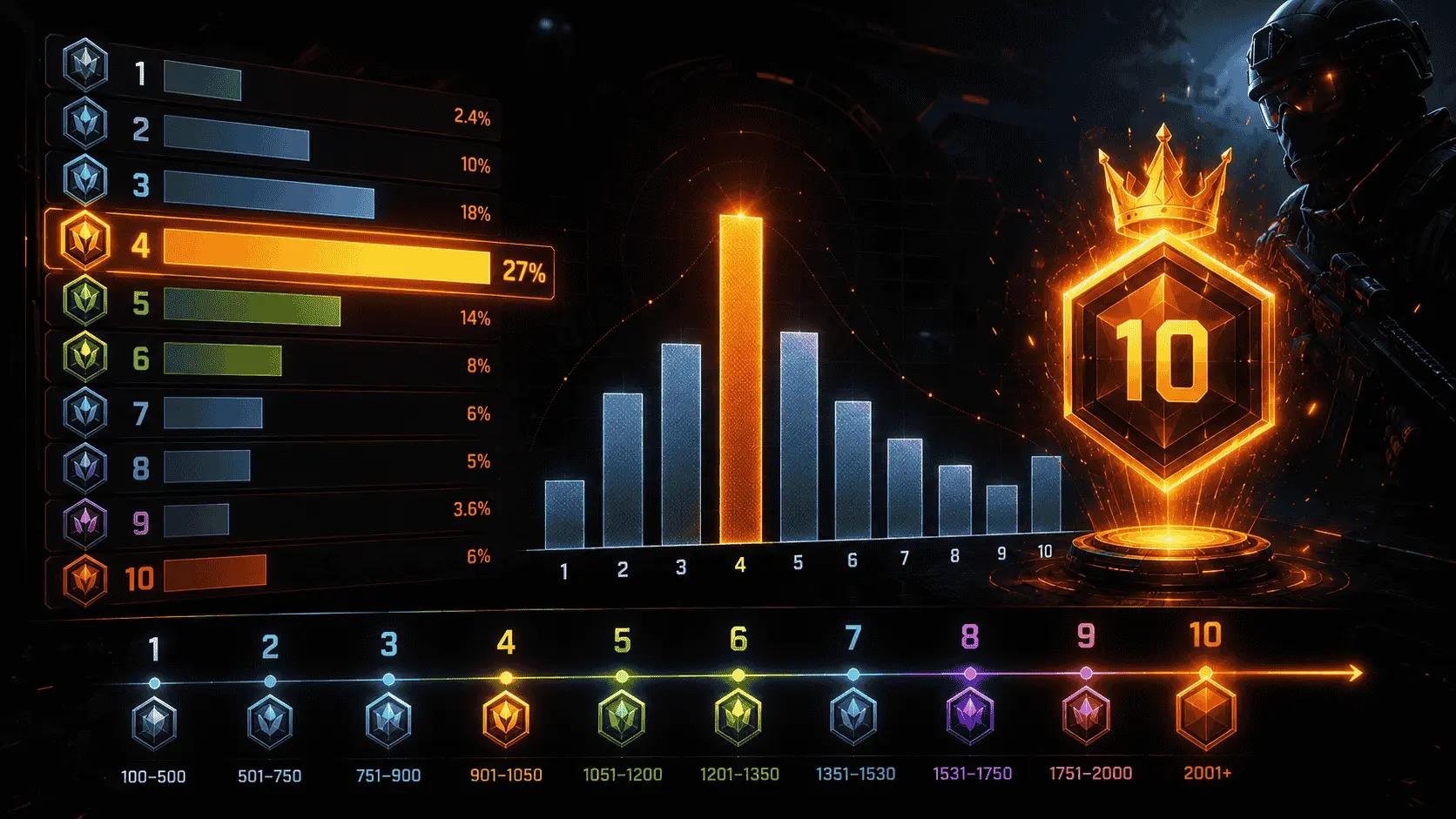
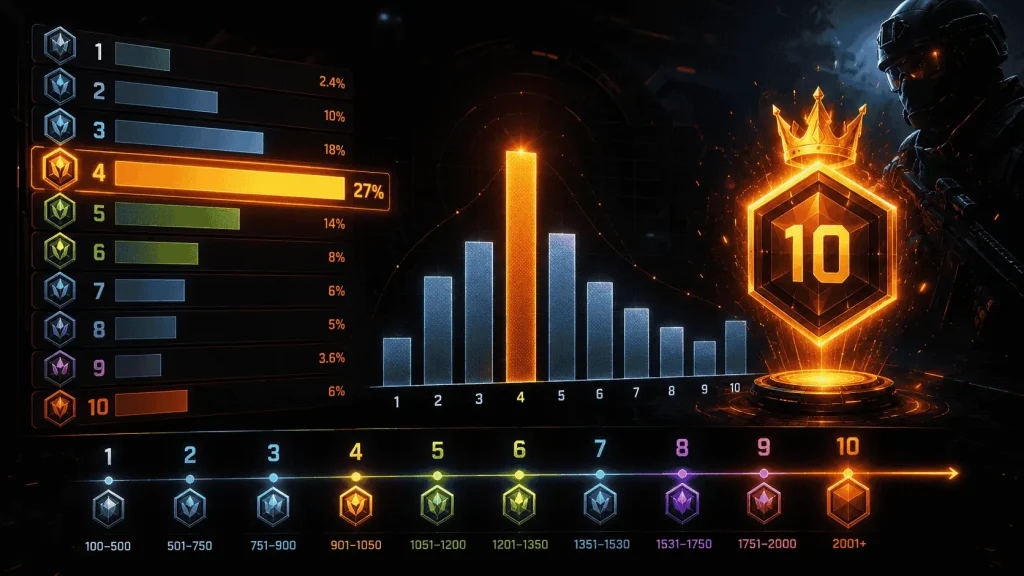
The clearest picture comes from FaceitAnalyser, a live tracker that has analyzed more than six million FACEIT CS2 accounts worldwide as of June 30, 2026. According to that data, Level 1 makes up a small slice of the player base, around 2.4 percent. Level 2 holds close to 10 percent, and Level 3 jumps up to about 18 percent. Level 4 is by far the largest group, holding roughly 27 percent of all players on its own. After that the numbers taper off again. Level 5 sits around 14 percent, Level 6 drops to about 8 percent, Level 7 is close to 6 percent, Level 8 sits near 5 percent, and Level 9 is the smallest fixed level at around 3.6 percent. Level 10, the open ended top tier, holds about 6 percent of the entire player base.
So instead of a smooth curve, the real shape of FACEIT’s player base looks more like a steep climb up to Level 4, followed by a long, gradual decline toward Level 10.
Why Level 4 Is the Most Common FACEIT Rank
This often confuses players who expect the most common rank to sit somewhere in the middle of the skill curve, not bunched up near the bottom. The real explanation has nothing to do with skill and everything to do with how new accounts are set up.
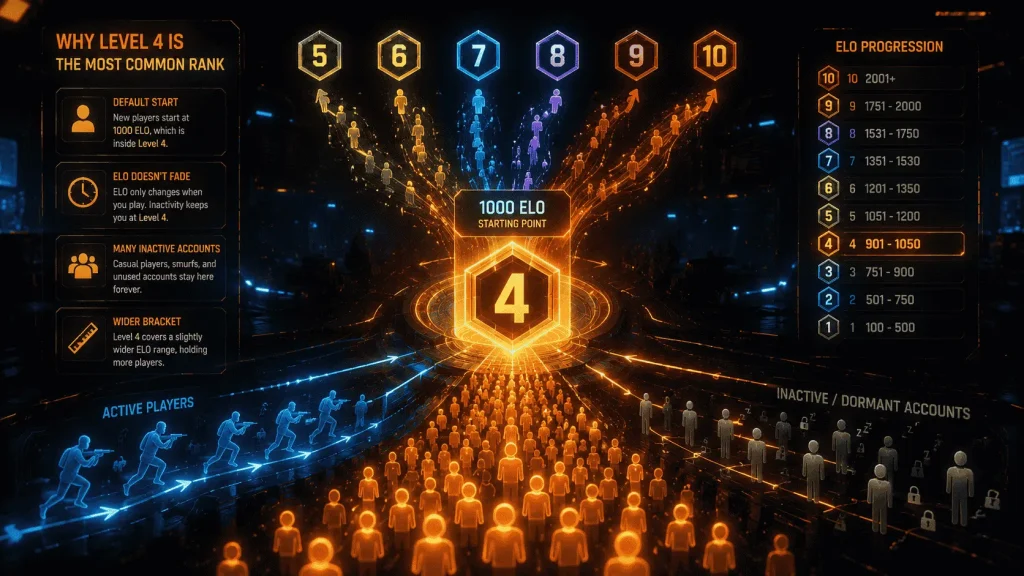
Every new FACEIT player who does not link a qualifying CS2 Premier rating is automatically placed at 1000 Elo to begin matchmaking. That starting number falls directly inside the Level 4 bracket, which runs from 901 to 1050 Elo. On top of that, FACEIT Elo does not fade away on its own if you stop playing. It only changes when you actually play matches. That means a huge number of casual players, smurfs, and accounts that were created once and barely touched again simply stay parked near Level 4 forever, since they never played enough matches to move away from where they started. The Level 4 bracket is also slightly wider than the bands directly above it, which gives it even more room to hold players. Put simply, Level 4 is not where the average skilled player ends up. It is where almost everyone starts, and a large share of accounts never leave.
FACEIT Elo Brackets for Each Level
Each FACEIT level corresponds to a fixed Elo range, except for Level 10, which has no ceiling. Level 1 covers 100 to 500 Elo, Level 2 covers 501 to 750, and Level 3 covers 751 to 900. Level 4 runs from 901 to 1050 Elo, which is where most new accounts begin. Level 5 spans 1051 to 1200, Level 6 spans 1201 to 1350, and Level 7 covers 1351 to 1530. Level 8 runs from 1531 to 1750, Level 9 from 1751 to 2000, and Level 10 begins at 2001 Elo with no upper limit at all. Worth noting, these bands are not evenly sized. Levels 1, 2, 8, and 9 cover wider Elo ranges than the levels around them, which is part of why population size and bracket width do not always line up neatly.
How FACEIT Season 8 Has Affected the 2026 Numbers
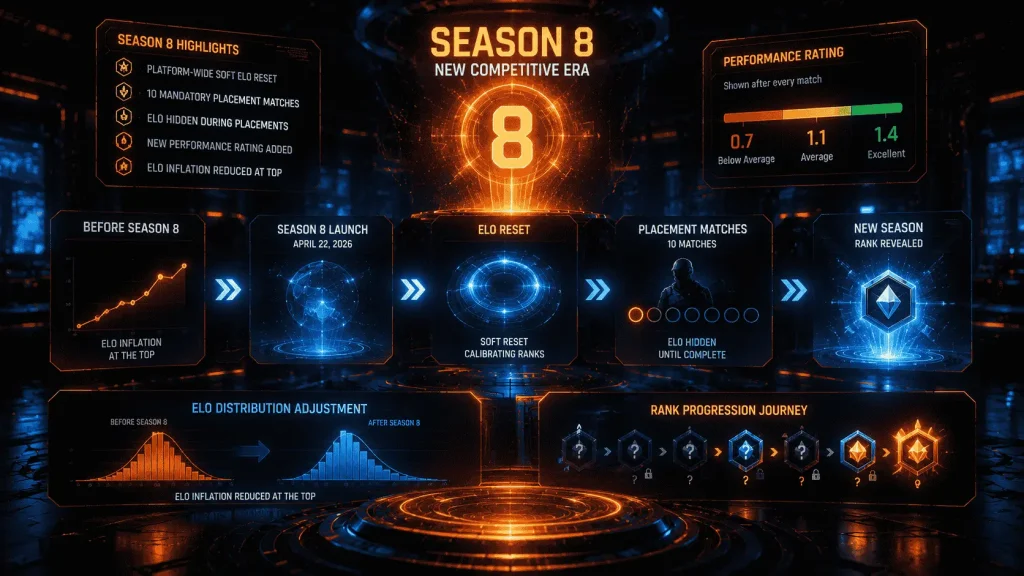
Any snapshot of the 2026 distribution comes with a timing caveat. FACEIT Season 8 launched on April 22, 2026, and for the first time applied a platform wide soft Elo reset alongside ten mandatory placement matches for every single player, not just those at Level 10. During those ten placement matches, a player’s Elo stays hidden until all ten games are finished, which means a portion of the player base has been moving through a temporarily unranked state at different points this season. The reset was also designed specifically to pull down long standing Elo inflation at the very top of the ladder, so high Level 10 accounts and Challenger players saw the largest downward adjustments of anyone on the platform. Season 8 additionally introduced a new stat called FACEIT Rating, which is shown after every match alongside your Elo. A rating of 1.4 reflects a strong performance, 1.1 is roughly the platform average, and 0.7 signals a below average match, though this rating does not change your level directly. Season 8 is scheduled to run until late July 2026, so everything in this guide should be treated as a mid season snapshot rather than a final number for the year.
Frequently Asked Questions
Conclusion
There is no single correct answer to how common or rare any FACEIT level is. It depends entirely on whether you are comparing yourself to every account FACEIT has ever issued, or only to the players who are actively grinding right now. Across the full account base, Level 4 dominates simply because that is where everyone starts and where inactive accounts get stuck. Among active, engaged players, Level 10 becomes the most common rank instead, since dedicated players tend to keep climbing over time. Wherever you currently sit, both datasets agree on one thing: getting through the early levels is mostly about playtime, while pushing past Level 7 or 8 is where real skill starts to separate players. With Season 8 still running until late July, expect these numbers to shift again once the season closes and the next reset begins.